Commercial

Boston Office Rents – March 2020 Update

alt tag

Demand for Boston office space is still high, and we have seen rent rates continue to rise.  The chart below is based on available data, but in practice we generally are not seeing the large gap in rents between Kendall Square and Harvard Square from Back Bay and the Seaport District that the chart indicates.
 

Office Rent Rates

Source: CoStar


With companies' office needs changing, many tenants are seeking to do shorter term leases than the 3-5 year minimum commitments that landlords generally prefer.  Companies looking for a long-term lease may consider one of the neighborhoods that has not seen rents increase as quickly as others, since they can present opportunities to lock in at a lower rate than that area might see.  

As rent rates continue to rise and with interest rates at record lows, it is also a great time for businesses to evaluate options to buy their office space rather than leasing.  Those opportunities can be harder to find, but they are out there - contact us to help you with that search.


Planning for a New Office in the New Year?

alt tag

The end of the year is a time when many businesses start planning for the year to come. With 2020 almost upon us, here is a quick look at the market conditions in a number of Boston's most popular areas for office space. We organized them in the order that we typically receive questions from businesses that are curious about the Boston [...]

Boston Retail Market Update - Fall 2019

alt tag

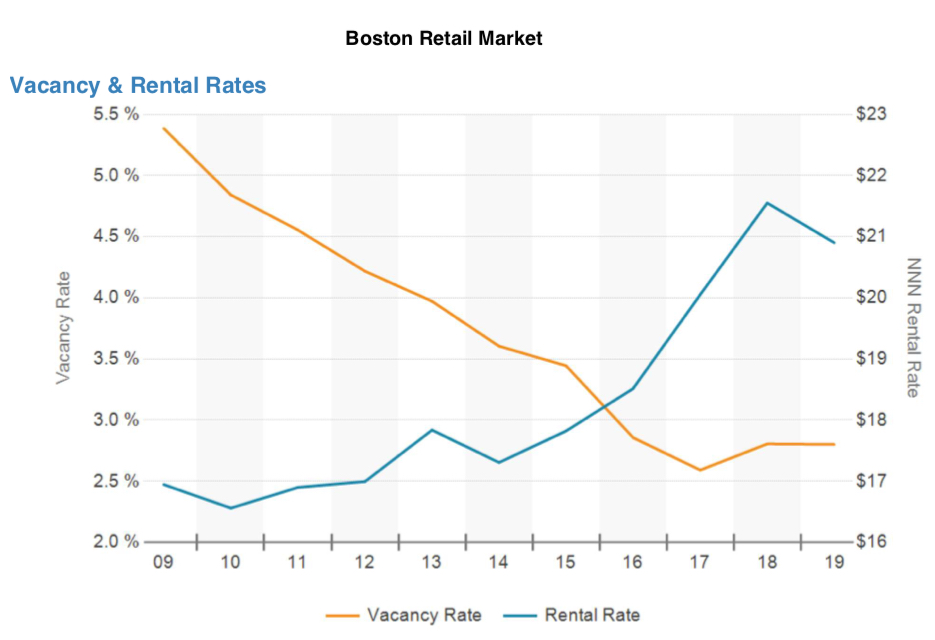
With Labor Day Weekend upon us, retailers are gearing up for the Fall/Holiday season.  It is a good time to take a look at the forecast for the retail market.  The news highlights trade tensions with China, the low interest rate environment and continued speculation that the U.S. economy is "due" for a recession.  But continued job growth is [...]

Micro Housing in Boston

alt tag

Good news for developers: Boston recently initiated a "Compact Living" pilot.  It's a two-year program that will allow developers to build so-called micro housing units in the City (though the preferred term is "compact unit" instead of "micro unit").  Boston has been considering such a policy for a while, and this two-year experiment will let the City determine how well it works.  

In order to build micro housing units in Boston, developers need to meet a number of standards.  This includes complying with design standards, inclusionary housing requirements and following specific processes and procedures for approval.

Micro housing is often a hotly debated topic.  Opponents typically raise concerns about density and displacing families (who need larger units to accommodate all family members).  On the other side, micro units help promote affordability by creating more units and they help fill an underserved area of housing demand (according to Boston, the number of single people and couples is 2/3 of the City's population, but the number of studio and one-bedroom units is only 1/3 of the City's housing stock).

For more details on the pilot specifics, click here for Boston's webpage on the Compact Living Pilot.  If you are a developer looking for micro housing opportunities in Boston, contact Eric Shabshelowitz to help with your search.


Update on Boston Business Trends

One economic indicator that many businesses and real estate investors monitor is employment.  The Boston Planning & Development Agency recently published a report titled “Trends in Boston Business Establishments & Payroll Employment”, which provides some useful data.  Here are some highlights:

  • In 2016, Boston’s total payroll and non-payroll jobs increased to 794,038, up from 669,423 in 2010.  Total jobs are forecasted to reach 829,000 by
  • [...]
11-20 of 28 Posts